User talk:Leduyquang753/Archive 1 - minecraft.fandom.com
Symbols for the division operation
Hi. I was planning to talk to you about the division operators and other math notations you used on Tutorials/Enchantment mechanics. Before I could get to it, I saw your last edit with the summary "so that everyone won't debate about whether to use : or / for division", and a little while ago I saw your topic on the Community Portal talk page. Those answered a lot of my questions.
Apparently, Vietnam uses the "decimal comma" convention. I was aware that the "," and "." symbols were reversed (relative to the U.S.) in some countries, but I'd never seen ":" used for the division operator. I don't think the British use it that way either, even though some U.K. countries use the decimal comma. Do you know of any other countries besides Vietnam that use ":"?
Also, in your last edit you returned to using ';' (semicolon) as the separator in [0; T). That's probably motivated by the decimal-comma convention too, although it's not actually part of it. In the U.S. (and on the wiki), commas are always used as separators in math. (There are exceptions in certain high-level math disciplines, but we wouldn't be using those on this wiki.)
I also wanted to point out that we traded edits over one bit for which we were both using the wrong notation. It's in Step Three, where you originally wrote "the segement [0; T]", which I changed to "the interval [0, T]", which you then changed again to "the half range [0; T)". All of those edits were wrong, because the text is describing how to choose a random integer. The square bracket notation is only used with real numbers, because it doesn't make sense with integers. For example, [0, T) (which is termed a "half-open interval", by the way) denotes all values n such that 0 ≤ n < T. But in the integer domain, the largest value less than T is T−1, so [0, T−1] would denote the same set of values. But there's no real advantage to using the bracket notation with integers, so integer ranges are usually denoted in English using one of the older conventions 0–T or 0…T. (A lot of our readers wouldn't have any idea how to interpret the bracket notation, anyway. We learn it in high school, but most people never use it after they finish school and they forget they ever knew it.)
In answer to your question on the Community Portal, I think there's a way to get CSS to change it in your browser, but the wikitext would have to mark it somehow (probably with a class). Typically, that would mean using a template to generate the necessary marker. But most editors wouldn't see the point of doing that, since they don't know your preferred notation even exists, so it would be hard to get them to comply. In other words, you'd probably have to do most of the wikitext editing yourself, and keep it updated when people take out the template calls because they don't know why they're needed. I'm sorry you find it challenging to interpret the English-based notation we use, but unfortunately I don't think there's a good solution for you.
– Auldrick (talk · contribs) 07:29, 24 October 2018 (UTC)
- OK, I will talk about this in a more detailed way.
- First, about the math notation, actually there isn't only one way of notating it in Vietnam. In education, primary school students use a cross (×) for multiplication, and when they go up to the secondary school, they are taught to denote it by a dot (.); and in any level, they use a space for digit grouping. However, people that are not students use a dot to group the digit instead (!). Even the currency of Vietnam use dots to group the digits for the value of money, e.g. 200.000 (two hundred thousand dong). So even in Vietnam itself this has already been pretty confusing, and after reading this you can understand why I can't adapt to a third, or even fourth, way of notation.
- Actually, I do code, and every programming language uses the US' format, because why not, and I usually mess up typing real numbers. For instance, there was one time I typed the coordinates for a triangle, which was supposed to be
{0f, 0.5f, 0f, -0.5f, -0.5f, 0f, 0.5f, -0.5f, 0f}, however because I am used to Vietnamese's kinda thing, I typed{0f, 0,5f, 0f, -0,5f, -0.5f, 0f, 0.5f, -0,5f, 0f}. The consequence was I wasted 20 minutes figuring out what caused the triangle to be a weird shape. Luckily, most of the time I work with integers, so that hasn't become a big problem.
- And for the intervals, I actually thought very carefully of it before entering. You can see my original phrase: "a random integer in the segment [0; T]". I later changed it to "[0; T)" because I was wrong. And both two are correct because although [0; T) is a set of any real number a that satisfies 0 ≤ a < T, but the word integer eliminates all the numbers that contain a meaningful decimal part. And why did I use segment and half range? In Vietnamese, [a; b] is called as "đoạn" which means "segment", [a; b) is "nửa khoảng" means "half range". I basically translated those to English. And I looked up Wikipedia, the page doesn't have any terminology for interval types, calling [a; b] as "closed interval" and [a; b) as "left-closed, right-open interval".
- For evidence, here is a page in the textbook "Algebra 10" in Vietnam that defines types of intervals:
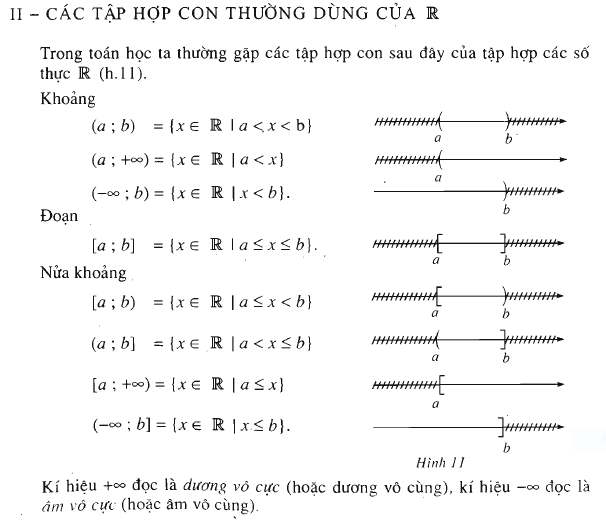

- "II - FREQUENTLY USED SUBSETS OF R
- In mathematics we usually meet these subsets of the set of real numbers R.
- Range
- (a; b) = {x ∈ R | a < x < b}
- (a; +∞) = {x ∈ R | a < x}
- (-∞; b) = {x ∈ R | x < b}.
- Segment
- [a; b] = {x ∈ R | a ≤ x ≤ b}.
- Half range
- [a; b) = {x ∈ R | a ≤ x < b}
- (a; b] = {x ∈ R | a < x ≤ b}
- [a; +∞) = {x ∈ R | a ≤ x}
- (-∞; b] = {x ∈ R | x ≤ b}.
- The symbol +∞ is read infinitely positive, the symbol -∞ is read infinitely negative."
- So I hope this answers many of your questions.
- P/S: You mentioned the problem of many readers not knowing what an interval notation means, I was not the first one to notate it. Before deciding to notate this way I read Far Lands#Cause which used the exact kinda notation:
- "a remainder in the interval [0, 1) suitable for interpolation. [...] It covers an interval of [-231, 231) without causing any problems. [...] Each noise generator picks a random offset in [0, 256) to add to its input."
- Lê Duy Quang (Make some words | Contributions) 12:44, 24 October 2018 (UTC)
- Thanks very much for the very thorough reply. I did want to direct your attention to this section on the Wikipedia article I was using. It supports my claim that bracket notation isn't usually used for integer intervals.
- As for Far Lands, that article is somewhat controversial. There have been attempts to get rid of it and impassioned pleas to keep it, and it's become kind of an orphan that the old-timers here tend to neglect rather than stir up more debate about it. The same is true with a lot of the tutorials. Because the old-timers mostly ignore these articles, many of them are of lower quality and shouldn't be consulted for examples of acceptable style. Just sayin'. – Auldrick (talk · contribs) 15:55, 24 October 2018 (UTC)
- That Wikipedia article was exactly what I referred. Indeed the intervals are originally to notate a subset of R, but as I said the word integer clearly restricted that set to integers only. If this notation is hard for readers, I may change it and may also rewrite the page Far Lands as well. Lê Duy Quang (Make some words | Contributions) 04:35, 26 October 2018 (UTC)
- The bracket notation is something we learn in high school, but hardly anybody needs it in their adult life so most people forget they ever knew it. (I didn't because I'm sort of a mathephile.) And of course, many of our readers are young children whom I think wouldn't have been exposed to it yet. So I'd recommend not using it unless the situation involves a lot of dense math where precision is important and which the average person couldn't follow anyway. Literally anybody should understand the X–Y notation (if only imperfectly), and I think most would understand X..Y if they've ever studied programming.
- I hope you don't feel I've ever talked down to you. (Is that an idiom you know? If not, it means something like "treat someone as an inferior in a speech act".) I try to adjust my vocabulary and sentence structure for my audience, but these days it's much harder with non-native-English speakers because a lot more of them (like you) are so much better at English than in the past, yet they still lack a lot of the cultural background and shared experience that's so important in communicating. I only just noticed on your user page that you're in grade 10; I was very uncertain of your age. Nevertheless, I have a lot of respect for your command of the many subtleties of English. So if at any time you felt disrespected, please accept my apology. – Auldrick (talk · contribs) 05:44, 26 October 2018 (UTC)
- Oh well I didn't feel anything that hurts my heart from you, maybe it's just me not being a native speaker of the most popular language in the world. In fact, your thoughts are very constructive and I appreciate. I am still very fine and happy as of now, so you can keep being yourself. Lê Duy Quang (Make some words | Contributions) 05:49, 26 October 2018 (UTC)
Proofreading Minecraft
Some of the changes you made to Minecraft in this edit were in error. I have corrected them, but thought you might like an explanation since you're working on your English skills.
- In some places you changed semicolons (';') to commas. In English, a semicolon can be substituted for a period between sentences to hint that the two statements are linked more strongly than a period would suggest; the second one explains or restates the first in some way, as it does in this sentence. (Most non-professional writers don't use semicolons this way, but they do understand them.) Using a comma to separate independent clauses creates a "run-on sentence", which is ungrammatical. If you feel a semicolon is misused, you should change it to a period, not a comma.
- Many of your edits modified links into deprecated form. Per MCW:Style guide#Linking, "Linking to a redirect is preferred over using a piped link" and "If a redirect can be avoided using a suffix on the link, that is preferred. E.g. Using
[[Creeper]]sinstead of[[Creepers]]is desired." Therefore it should be [[mob]]s (suffix), then [[mobs]] (plural redirect), then [[mob|mobs]] (piped link), in order of preference. Note that using suffixes also works correctly with{{ItemLink}}s. - The plural of "sheep" is "sheep", and the plural of "squid" is "squid" (with no -s in either case). Plurals for food and meat items are highly irregular. You have to learn them one by one, because the rules are a complicated mix of Old English and Medieval French from when France ruled the south of England.
Some other quasi-grammatical errors I corrected were:
- In the Blocks section, you ended a sentence with an ellipsis ("..."). When a sentence ends with an ellipsis, it still needs a period to end the sentence. (Note, however, that this is considered poor style because it's hard to read.) In this case, the sentence already indicated they were examples, which implies an incomplete list, so the ellipsis was redundant and I removed it.
- Also in Blocks, you replaced a semicolon with a comma. In this case, that would have been correct because what followed it wasn't an independent clause. Unfortunately, you also changed a gerund ("being") to a finite verb ("include"), which made the second part an independent clause and the sentence as a whole a run-on sentence. Either change by itself would have been correct but together they were ungrammatical.
- In the Mobs section, you ended the list items with periods. These are not complete sentences, so they should not end with periods. Some of them would have been sentences if the colon were omitted, but even so, list entries are not usually ended with periods unless they are nontrivial and written in the style of an ordinary prose paragraph (like this list). There's some ambiguity here, because you definitely shouldn't use periods in a list of single words or terms, while you definitely should use them in a list of paragraphs, so intermediate and mixed cases might go either way.
- In the Multiplayer section, you edited "the internet" to "the Internet". I left this change because it is not technically wrong. However, be aware that experts, even those who recommend capitalizing it, acknowledge that the proper noun has become so common as to be evolving into a new meaning of the common noun. Our standard is American English, where it is more common to capitalize it (in contrast to Britain), but the non-capitalized usage is considered only slightly informal, not incorrect, so this only needs to be corrected if it's inconsistent with the rest of the article.
– Auldrick (talk · contribs) 19:18, 29 October 2018 (UTC)
- OK I guess I have to explain these one by one.
- A semicolon separates two clauses in a sentence, or entries in a list. In my edit I changed:
- Some blocks cannot be broken through normal survival means; these being Bedrock, End Portal Frames, and Command Blocks.
- to:
- Some blocks cannot be broken through normal survival means, these include Bedrock, end portal frames, command blocks, barriers,...
- which actually I was going to change "these being" to "including" but somehow I messed up a bit and forgot. Please accept my apologies.
- When I saw the links with the suffixes being thrown outside the double brackets, I thought it would make much, much more sense by making links that cover the whole words. One example of this is the word "administrator". I thought if the user wants to know about "administrator", they will point their cursor to the word and click it. If it is just
[[Admin]]istratorthen there is a high chance that the user will click on the latter part of the word, causing them to feel this is broken. Even if they pointed to the right part, the underline for the link would be severely shorter than the word, making it seriously ridiculous. So I changed it.
- When I saw the links with the suffixes being thrown outside the double brackets, I thought it would make much, much more sense by making links that cover the whole words. One example of this is the word "administrator". I thought if the user wants to know about "administrator", they will point their cursor to the word and click it. If it is just
- However, I just previewed the links and found out the link automatically covers the whole word, so yeah, now your argument makes sense.
- The plurals, OK I was wrong, just keep. Maybe next time I will have to look up Wiktionary every time I use plural forms.
- Blocks
- The ellipsis is a common way to indicate a list is not complete in Vietnamese. Actually there are substitutes for "etc." like "vân vân" shortened as "v.v.", "và vài/nhiều cái khác" (and some/many more),... but less common. However, I agree with you to remove that ellipsis because the sentence included "these include". Like I said above, the comma was because I meant to change that to "including".
- Mobs
- You can see each entry in the list is a complete sentence, however for the beauty of a list I added a colon. If I removed it then you would probably argue again that a list with no colons makes no sense. If the entry was just a word then I absolutely agree not to place a period in the end. Actually a substitute for this is again the semicolon, we can use that instead if you feel it is better.
- Multiplayer
- The word Internet is a proper noun, so not capitalizing it is a mistake and looks ridiculous.
- So yeah, you have done a really good job as a patroller and fixed my errors; I have no complaint about your changes at all. Those are really good to make the wiki better.
- Lê Duy Quang (Make some words | Contributions) 00:25, 30 October 2018 (UTC)
- A few of your statements are either misunderstandings or cultural differences:
- "A semicolon separates two...entries in a list." Not precisely true, at least in English. Per wikipedia:Semicolon, "Semicolons can also be used in place of commas to separate items in a list, particularly when the elements of that list contain commas" [emphasis added]. This is expanded later to include list elements with internal punctuation, but nowhere does it describe using them in the absence of conflicting punctuation. In practice, this rule is rarely applied, and many people only remember it vaguely, if at all.
- "The ellipsis is a common way to indicate a list is not complete in Vietnamese." It is also used this way in English, but it has a connotation that perhaps it lacks in Vietnamese. Specifically, it implies that the author is taking a shortcut, either because the rest of the list is unimportant or because the reader already knows what was omitted. That's fine in other contexts, but it doesn't apply on the wiki, and I doubt you could find many examples of ellipses here.
- "You can see each entry in the list is a complete sentence..." Why do you say that? Some of the entries do not even have a verb, and therefore cannot be complete sentences in English. For those that do have a verb, the colon is what makes them not a sentence because it divides the subject from the rest of its clause. "...however for the beauty of a list I added a colon." Perhaps I wasn't clear, since you think I dislike your colons. They are fine. They aren't required and most lists don't use them, but I like them here and think they add elegance to the list. I only meant to say that the periods should not be there, since the list isn't a series of paragraphs. This is more a style opinion than a grammatical rule, and we don't have a consensus established for it on the wiki, but I know some other editors agree with me.
- "The word Internet is a proper noun, so not capitalizing it is a mistake and looks ridiculous." As I was trying to point out to you, it is not definitively a proper noun any longer. Its meaning has mostly been subsumed by the common noun, whose earlier meaning is now rarely used. (This kind of shift in meaning happens a lot in English, though it might seem odd in other languages.) So the uncapitalized usage is quite acceptable, just (perhaps) slightly less formal in style; it is not a spelling or grammar mistake. You can confirm this on Wikipedia:Capitalization of "Internet". As for whether it "looks ridiculous", I don't know whether that's a personal opinion or a cultural bias, but I assure you most native English speakers don't share it.
- Respectfully, – Auldrick (talk · contribs) 05:06, 30 October 2018 (UTC)
- A few of your statements are either misunderstandings or cultural differences:
- I was a bit hasty when I said each entry in my list was a complete sentence. I have reviewed my own list:
- Zombies: attack by melee and summon other zombies.
- This is indeed a sentence with a colon.
- Endermen: tall, black creatures with purple eyes and turn aggressive when the player looks at them.
- In this case the colon can be treated as a "substitute" for "to be".
- Those are the two types of entry I used in the list, to prove that my periods have at least a reason (I didn't say I was right). A sentence between two line feeds is still a paragraph.
- For the ellipsis, I don't get your specification of the writer "taking a shortcut". It works the same as et cetera in my humble opinion. The reader of course know the type of the omitted entries based on the listed ones.
- And for "the Internet", this has been a long debate, so I won't pour more oil into the flame. We stop here.
- Lê Duy Quang (Make some words | Contributions) 06:11, 30 October 2018 (UTC)
- In English, at least, an ellipsis has an entirely different meaning than etcetera. If you are in very informal settings, you may have sentences such as "this, and that, and this other, and that other..." but as you can see it uses "and" as a delimiter and just using commas there with the ellipsis will look quite wrong. When the list starts with "including" or some form of that "etc" or anything else is not needed at the end of the sentence. – Nixinova

 06:19, 30 October 2018 (UTC)
- In English, at least, an ellipsis has an entirely different meaning than etcetera. If you are in very informal settings, you may have sentences such as "this, and that, and this other, and that other..." but as you can see it uses "and" as a delimiter and just using commas there with the ellipsis will look quite wrong. When the list starts with "including" or some form of that "etc" or anything else is not needed at the end of the sentence. – Nixinova
- Lê Duy Quang (Make some words | Contributions) 06:11, 30 October 2018 (UTC)
- I have acknowleged that and agreed the removal of the ellipsis in my first reply. Otherwise, the commas with the ellipsis is one billion percent normal in my writings. Lê Duy Quang (Make some words | Contributions) 06:49, 30 October 2018 (UTC)
Template:LDQS
Signature templates should go in your userspace (for example, User:Leduyquang753/Signature). – Nixinova 04:39, 10 November 2018 (UTC)
Thank you. I have moved the template, but to shorten the syntax I still left a redirect behind... Lê Duy Quang (Make some words | Contributions) at 5h | 10/11/2018
Slime_Revision_1.png
Thank you for making a render. You are a gentleman and a scholar.tangeruse 21:05, 17 November 2018 (UTC)
List of files to render in 300x300
Here's a list of block files that need to be in 300x300 instead of 150x150. Probably missed many.
- https://minecraft.gamepedia.com/File:Oak_Log.png
- https://minecraft.gamepedia.com/File:Spruce_Log.png
- https://minecraft.gamepedia.com/File:Birch_Log.png
- https://minecraft.gamepedia.com/File:Jungle_Log.png
- https://minecraft.gamepedia.com/File:Acacia_Log.png
- https://minecraft.gamepedia.com/File:Dark_Oak_Log.png
- https://minecraft.gamepedia.com/File:Stone.png
- https://minecraft.gamepedia.com/File:Stone_Bricks.png
- https://minecraft.gamepedia.com/File:Mossy_Stone_Bricks.png
- https://minecraft.gamepedia.com/File:Cracked_Stone_Bricks.png
- https://minecraft.gamepedia.com/File:Chiseled_Stone_Bricks.png
- https://minecraft.gamepedia.com/File:Mossy_Cobblestone.png
- https://minecraft.gamepedia.com/File:Gravel.png
- https://minecraft.gamepedia.com/File:Andesite.png
- https://minecraft.gamepedia.com/File:Polished_Andesite.png
- https://minecraft.gamepedia.com/File:Diorite.png
- https://minecraft.gamepedia.com/File:Polished_Diorite.png
- https://minecraft.gamepedia.com/File:Granite.png
- https://minecraft.gamepedia.com/File:Polished_Granite.png
- https://minecraft.gamepedia.com/File:Clay_Block.png
- https://minecraft.gamepedia.com/File:Obsidian.png
- https://minecraft.gamepedia.com/File:Netherrack.png
- https://minecraft.gamepedia.com/File:Nether_Bricks.png
- https://minecraft.gamepedia.com/File:Soul_Sand.png
- https://minecraft.gamepedia.com/File:Brown_Mushroom_Block.png
- https://minecraft.gamepedia.com/File:Red_Mushroom_Block.png
- https://minecraft.gamepedia.com/File:Mushroom_Stem.png
- https://minecraft.gamepedia.com/File:Snow_Block.png
- https://minecraft.gamepedia.com/File:Prismarine_Bricks.png
- https://minecraft.gamepedia.com/File:Dark_Prismarine.png
- https://minecraft.gamepedia.com/File:Sponge.png
Please avoid anti-aliasing in block renders
As stated in Minecraft Wiki:Standardized views, anti-aliasing should be avoided in renders because it's not used in-game.--Capopanzone (talk) 20:26, 22 November 2018 (UTC)